
Swain County Parole and Probation Defined
“Released” describes a custody change, not necessarily the end of a criminal sentence. A bond release from the Swain County Sheriff’s Office & Jail is not parole, probation, or post-release supervision by itself. The court may impose probation, and the North Carolina Department of Adult Correction may administer post-release supervision or parole after state imprisonment.
Probation is court-imposed community supervision that may replace all or part of incarceration. Post-release supervision is the statutory community portion that follows imprisonment for covered modern felony sentences. Parole is discretionary conditional release, now relevant chiefly to older or specially governed sentences. Discharge is completion or termination of the applicable supervision or sentence, not merely departure from a jail or prison.
| Status | Who imposes or administers it | What it does not prove |
|---|---|---|
| Probation | A court imposes it; NCDAC Community Supervision ordinarily administers it. | It does not prove a person served a state-prison term. |
| Post-release supervision | North Carolina law requires it after the prison portion of covered sentences; NCDAC administers it. | Prison release does not mean the whole sentence has ended. |
| Parole | The North Carolina Post-Release Supervision and Parole Commission makes conditional-release decisions in eligible cases. | Eligibility or a favorable review does not prove actual release. |
| Bond release | The court sets the legal terms, and the jail records physical exit. | It is not a supervision classification and the criminal case may remain open. |
Verify Swain County Post-Release Supervision
The public starting point is NCDAC Offender Public Information, or OPI. It can expose distinct probation, parole, and post-release fields. Because names repeat, a name match alone is not enough. Compare the offender number, date of birth or age, and other displayed identity fields before relying on a status. Then use the current agency directory rather than an old office list, since assignments may change.
- Open the official NCDAC OPI search and search by offender number when one is known.
- Otherwise use the person’s name and narrow the candidates with legitimate identity fields shown by OPI.
- Open the matching result and read probation, parole, and post-release status separately. Do not infer one from another.
- Review the most recent incarceration, location, movement, and actual release fields only within their stated scope.
- Use NCDAC Community Supervision and the Swain court directory to identify the proper current contact.
- For a claimed completion, seek the relevant discharge, termination, or court record instead of treating “out of custody” as final proof.
Note: OPI covers state corrections and public supervision history, not the Swain County jail’s complete booking and release archive.
A person who no longer appears in a current jail view may have been released on bond, transferred, or moved into NCDAC custody. The Swain jail record establishes its physical exit event, while OPI supplies state custody and supervision status. The Swain County released-inmate search path explains how those records fit together.
Public Status, Privileged Case Detail
OPI can establish the basic public fact that a matched person has an active or inactive supervision status. It does not make an officer’s full working file public. North Carolina G.S. 15-207 treats probation officers’ detailed information as privileged. Readers should expect a public status check to be narrower than the information available to the court, NCDAC, or a supervising officer.
The source also depends on the question. For the original judgment, probation term, modification, revocation, or termination order, use the North Carolina court record and the Swain County court contact directory. For the basic state supervision status and agency route, use OPI and NCDAC. For the actual time someone left the Law Enforcement Center at 95 Brendle Street, use the jail’s booking and release record. None of these sources should be stretched beyond the event it records.
North Carolina Conditions and Violations
Supervision conditions come from the governing judgment, statute, and agency action. They can differ by sentence and person. The public should not assume a condition merely because it is common in another case. A claimed violation also is not the same thing as a completed revocation. The court or Commission process determines the legal consequence, while OPI may later show a changed public status.
At a high level, supervision requires compliance with the valid conditions assigned to the person and continued contact with the supervising authority. Allegations may produce investigation, a court filing, a Commission response, or another official action. If a person is returned to custody, that event may create a new jail or NCDAC record. The relevant order and custody record should be read together before describing the outcome.
Note: An arrest, alleged violation, status change, revocation, and final discharge are separate events and should be reported with their own dates.
NC SAVAN notifications can help track a later custody change when a supervised person returns to a participating jail or NCDAC prison record. The alert does not explain whether the event arose from a violation, a new case, or another legal cause. It also does not replace the order that authorizes confinement or release. Match the reporting agency and offender ID, then review the court or Commission action that fits the event. County-jail and NCDAC identifiers may require separate registrations, so one alert subscription should not be assumed to follow a person across both systems.
Swain County Absconder Status Is Not Discharge
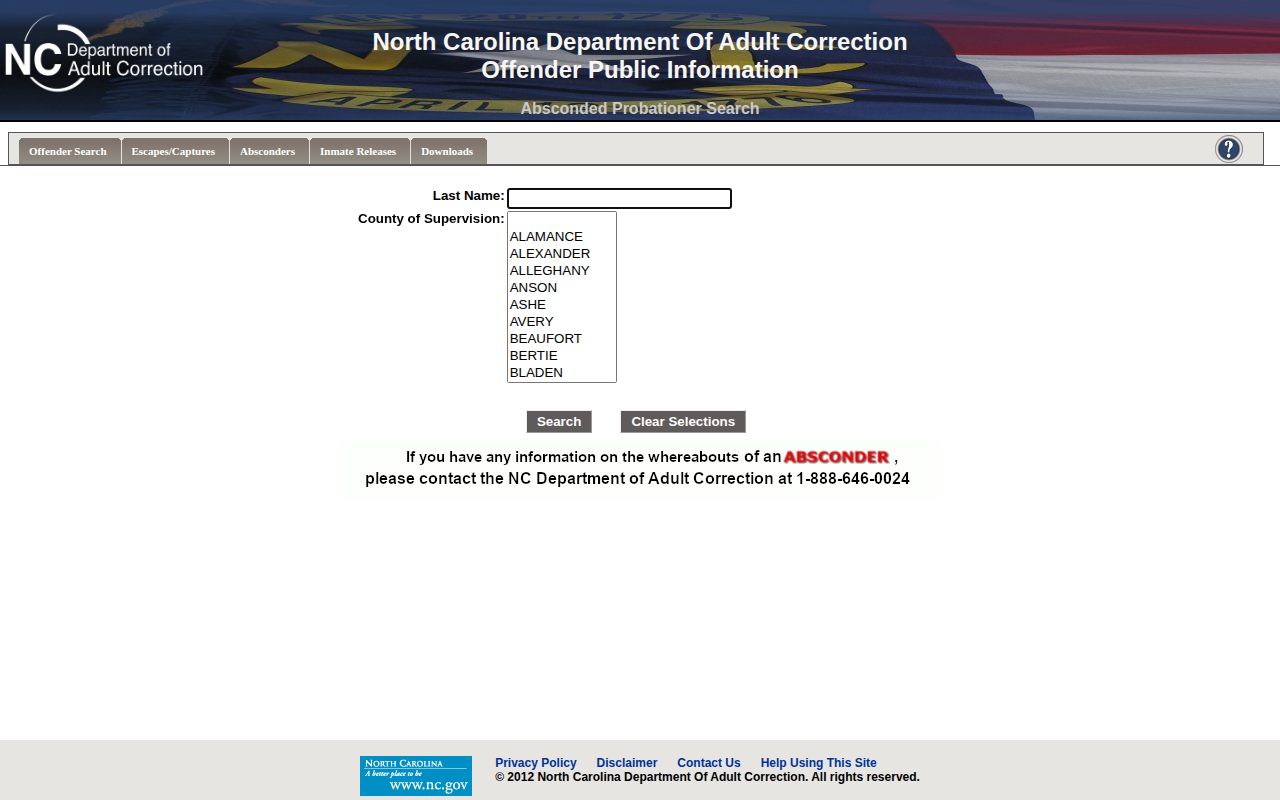
North Carolina maintains a dedicated absconder search apart from the ordinary OPI search. Under G.S. 15A-1368.4(e)(7a), absconding includes willfully avoiding supervision or willfully making one’s whereabouts unknown to the supervising officer. A result therefore signals an unresolved supervision condition. It does not mean the person completed supervision, and it does not establish the end of a sentence.
Use the official NCDAC absconder search with careful identity matching. Then contact the relevant agency if official action or clarification is needed. A private reader has no authority to detain, pursue, or confront anyone based on a search result.
The manifest capture below comes from the official North Carolina absconder interface. Its separation from OPI matters because an ordinary status lookup and an absconder query answer different questions.
Swain County Parole Review Records
The North Carolina Post-Release Supervision and Parole Commission handles eligible parole matters. Parole in its former form was eliminated for Structured Sentencing offenses committed on or after October 1, 1994. Pre-cutoff offenses may remain eligible, subject to exceptions, and NCDAC identifies a limited post-cutoff group involving juveniles sentenced to life with the possibility of parole. Eligibility depends on the offense date, governing sentencing regime, offense, and judgment, so a public reader should not calculate it from sentence length alone.
North Carolina does not publish an ordinary calendar of formal individual parole hearings because the usual process is file review. Commissioners review and vote independently rather than holding a routine group hearing. The published cadence is generally at least annual for ordinary eligible cases, every three years for first- or second-degree murder cases, and every two years for sexually violent offense cases. A narrow juvenile videoconference review exception does not create a general public calendar.
The Commission’s Discretionary Parole Reviews page publishes retrospective monthly results beginning in September 2024. Categories include Regular Parole, Community Service Parole, Early Medical Release, 90-Day Mandatory Parole, Incomplete Decision, Suspend Decision, and Denial. These results are not an upcoming schedule and are not necessarily a name-search database. Underlying Commission records remain confidential.
A grant or scheduled decision still needs comparison with OPI’s Actual Release Date. A decision can be conditional, incomplete, suspended, rescinded, or changed by later events. Actual release from imprisonment may also begin a period of supervision rather than end the sentence.
How Swain County Supervision Ends
Each form of supervision has its own termination route. Post-release supervision ends under the applicable sentence and G.S. 15A-1368.2. Parole termination is addressed by G.S. 15A-1372(c). Probation length, discharge, and termination depend on the judgment and G.S. 15A-1342. A completed jail stay does not substitute for any of those later milestones.
For a clean record trail, preserve the date and exact label shown by each source. The jail release date concerns the Swain custody episode. An OPI Actual Release Date concerns NCDAC imprisonment. A probation termination order concerns court-imposed supervision. A parole or post-release discharge concerns the relevant state sentence. If two sources appear to conflict, first compare their agency scope and update time.
A targeted public-record request may help when a visible status lacks context, but the requester should ask for existing public fields instead of an officer’s privileged case notes. NCDAC is the custodian for its correctional and supervision records, the Swain clerk holds the court file, and the Sheriff’s Office holds its jail release record. North Carolina public-record law does not require an agency to create a new explanation or custom calculation that it does not maintain.
Official supervision contacts
North Carolina Department of Adult Correction
Use Community Supervision and OPI for public status and current office routing.
Swain County court
Use the clerk’s directory for judgments, probation orders, and court-file access. The county directory also lists the Clerk of Court number.
Swain County Sheriff’s Office & Jail
95 Brendle St., Bryson City, NC 28713
828-488-0159
Administrative office hours: Monday through Friday, 8:00 a.m. to 5:00 p.m.
Official Sheriff and jail page